The Practical Buyer’s Guide to Portable Power
When you shop for a power bank, you are hit with a wall of numbers, acronyms, and marketing terms. Some of these specifications are critical to how fast your devices will charge, while others are simply noise designed to make a mediocre battery look impressive.
This guide will help you filter that packaging copy, focus on the specifications that actually impact your daily use, and combine your battery with the right chargers and cables to build a reliable power kit.
Part 1: Decoding the Retail Packaging
When shopping for a power bank, you are balancing physical trade-offs against electrical performance. Before looking at specific protocols, it helps to understand the baseline factors that govern how these devices work, how to read their capacity metrics, and how to spot marketing noise.
The Five Core Factors of Portable Power
Every power bank is defined by five main attributes. Understanding what qualifies as a low, average, or high value for each will help you quickly evaluate any option:
- Capacity (The Energy Tank): This dictates how many times a battery can recharge your devices before it goes flat.
- Low: 5,000 mAh (good for one emergency phone top-up).
- Average: 10,000 to 15,000 mAh (the standard for daily use; charges a phone 2 to 3 times).
- High: 20,000 to 27,600 mAh (heavy-duty; can charge laptops or keep a phone alive for a week).
- Power Output (Charging Speed): Measured in Watts (W), this is the speed at which the power bank can push energy into your devices.
- Low: 10W to 15W (slow; takes hours to charge a modern phone).
- Average: 20W to 30W (standard fast-charging speed for iPhones, Pixels, and Galaxy devices).
- High: 65W to 140W+ (high-speed; required to power and charge laptops).
- Power Input (Recharging Speed): Also measured in Watts (W), this is how quickly the power bank can pull energy from a wall charger to refill itself.
- Low: 10W to 15W (a large battery will take all night or over 12 hours to refill).
- Average: 30W to 45W (refills a standard battery in 2 to 3 hours).
- High: 65W to 100W+ (can fully replenish a massive laptop-grade battery in about an hour).
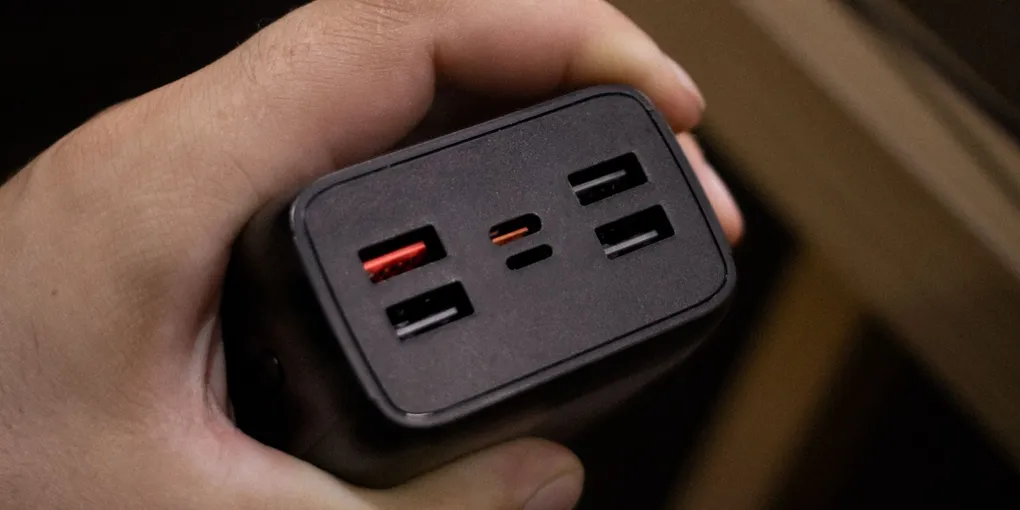
- Ports (Connectivity): The physical slots where you plug in your cables. Modern devices prioritize USB-C ports, which handle both input and output. Older USB-A ports are strictly for output and are limited to slower speeds.
- Size and Weight (Portability): Battery cells have physical limitations; more capacity requires more physical volume and weight.
- Low (Pocketable): Under 200 grams (roughly the weight of a standard smartphone).
- Average (Bag-friendly): 300 to 450 grams (noticeable in a pocket, easy in a backpack).
- High (Heavy): 550 to 700+ grams (brick-sized; designed to sit on a desk or inside a travel pack).
Features to Look For
Once you understand the basic metrics, you can evaluate the specific technical standards listed on the packaging. These terms dictate exactly how the power bank manages its Power Input and Power Output:
- USB-PD 3.0 / PD 3.1 (Power Delivery): This is the universal standard for high-speed charging over USB-C. It regulates both Power Output and Power Input. When a power bank has USB-PD, it can fast-charge your phone and use that same standard to rapidly refill itself when plugged into a compatible wall block. PD 3.0 covers power up to 100W, which handles phones, tablets, and mid-sized laptops. PD 3.1 scales up to 140W and beyond, which is only necessary for large, high-performance laptops.
- PPS (Programmable Power Supply): This is an optional sub-standard of USB-PD that specifically controls Power Output. It allows the power bank to dynamically adjust its voltage and current in real-time based on your phone’s battery state. In theory this allows more efficient charging, lower temperatures, and longer battery lifetime.
- Aviation Limits: Because lithium batteries can pose a fire hazard if damaged, aviation authorities regulate them strictly by their total capacity. Generally any power bank with a capacity less than about 27,000 mAh can be carried legally onto a commercial flight in your carry-on luggage. Depending on your airline and region, anything over this may require explicit airline approval or else be confiscated at airport security checkpoints. See our guide to flying with power banks for more details.
Understanding the Fine Print (What to Look Past)
Packaging terms are rarely outright lies, but they are frequently presented in ways that obscure real-world behavior. Here is how to interpret the numbers accurately so you are not caught off guard.
Interpreting Combined Multi-Port Wattage
Manufacturers frequently print large numbers on the box like “65W Total Power!” Total wattage is a highly relevant stat because it tells you the absolute maximum capacity of the internal circuit board. However, you must understand how that total power is distributed across the Ports.
If a battery claims 65W total power, it almost never means you can plug in three devices and get 65W of fast charging on all of them. Instead, the power bank splits the total pool. It might allocate 45W to the primary USB-C port for a laptop, and split the remaining 20W between the other ports for a phone and wireless earbuds. If you are buying a battery specifically to charge a single power-hungry device like a laptop, do not look at the total power; look for the single-port maximum output specification.
Decoding Proprietary Fast-Charging Labels
You will often see logos or compatibility lists featuring terms like SuperVOOC, Warp Charge, SuperCharge, or TurboPower. These are proprietary protocols developed by individual smartphone manufacturers to achieve extreme charging speeds by using custom charging chips and specialized cables.
- SuperVOOC / Warp Charge: Developed by Oppo and shared by OnePlus and Realme. It uses high current (amperage) rather than high voltage to charge devices rapidly without generating excessive heat inside the phone.
- SuperCharge: Huawei’s proprietary standard, which similarly adjusts voltage and current dynamically using a dedicated protocol.
- TurboPower: Motorola’s branding, which is typically a modified version of Qualcomm’s Quick Charge standard or USB-PD, optimized for their specific battery layouts.
Why you can generally look past them: These protocols are closed ecosystems. A power bank featuring “SuperVOOC” will only deliver those extreme speeds if you are using an Oppo/OnePlus phone and a proprietary cable. If you plug an iPhone, Google Pixel, or Samsung phone into that same port, the power bank cannot communicate using that custom language. It will safely drop back to basic, slower USB speeds. Unless your entire device ecosystem matches that specific brand, prioritize universal USB-PD compliance over proprietary labels.
The Reality of Integrated Miniature Solar Panels
Power banks with a small solar panel glued to one side are often marketed as emergency survival tools. While the concept is appealing, the physical size of the panel makes it functionally ineffective.
Because of their tiny surface area, these integrated panels typically generate less than 1.5 Watts of power under ideal conditions. To fully charge a standard 10,000 mAh battery, the device would need to sit in direct, unclouded, midday sunlight for roughly 50 to 100 hours. Because leaving a lithium battery in direct, scorching sunlight causes thermal degradation and shortens its lifespan, these panels add physical weight and failure points without offering a practical way to redeem your Power Input.
Part 2: Building Your Purpose-Driven Power Kit
A power bank is only as good as the components surrounding it. If you pair a premium battery with a cheap cable or a weak wall plug, you create immediate bottlenecks.
By thinking of your charging gear as an interconnected kit, you can optimize for weight, speed, and reliability based on what you are doing.
Kit 1: The Daily Commuter (Minimal Bulk, Maximum Frictionless Setup)
Designed to fit comfortably in a pocket or small bag for a workday or evening out without adding noticeable weight.
- The Anchor Battery: A slim 10,000mAh power bank. At this capacity, you want to prioritize physical size. Look for a unit that features an integrated, flat USB-C cable. This eliminates the need to carry an extra cord and prevents tangles in your bag. Ensure it supports at least 22.5W or 30W PD output to fast-charge a phone to 50% in roughly half an hour.
- The Wall Companion: A miniature 30W GaN (Gallium Nitride) wall charger. GaN technology replaces old silicon internals, allowing the charger to be roughly the size of a coin while still offering full fast-charging speeds.
- The Cable: If your battery does not have an integrated cable, opt for a short, 0.5-foot flexible silicone USB-C to USB-C cable. Short cables do not snag when your phone is charging inside a jacket pocket or purse while you are walking.
- The Operational Insight (Pass-Through Charging): Look for a battery that explicitly supports pass-through charging. When you find a wall outlet at a coffee shop or hotel, you can plug the wall charger into the wall, the battery into the charger, and your phone into the battery. This charges both devices simultaneously using only a single wall outlet and a single kit.
Kit 2: The Digital Nomad (The 100W Flight-Ready Powerhouse)
Built for remote workers, business travelers, and anyone who needs to keep a laptop, tablet, and phone alive during long transit days or power grid failures.
- The Anchor Battery: A large-capacity power bank ranging between 24,000mAh and 27,600mAh. This sits right at the legal limit for commercial flights. It must support a single-port output of at least 65W, though 100W or 140W is preferred if you run a high-draw machine like an 11-inch or 16-inch laptop.
- The Wall Companion: A multi-port 100W (or higher) GaN desktop charger. It should have at least two USB-C ports and one USB-A port so you can quickly replenish your laptop and your massive power bank at the same time from a single airport or hotel outlet.
- The Cable: A 6-foot, e-marked USB-C to USB-C cable rated for 100W or 240W. Standard, cheap USB-C cables are hard-capped at 60W for safety reasons. To draw anything higher for a laptop, the cable must have an internal electronic chip (an e-marker) to tell the devices it can safely handle the higher current.
- The Operational Insight (Port Allocation Profiles): When buying a multi-port battery for this kit, look up its documentation to see how it splits power. For example, if you plug a laptop and a phone into a “100W” battery at the same time, does it drop the main port to 45W and give the phone 20W? Ensure the main port’s dropped wattage still stays above your laptop’s minimum charging threshold, or your laptop may refuse to charge entirely while your phone is plugged in.
Kit 3: The Wilderness Backpacker (Rugged, Weather-Resistant, & Weight-Optimized)
Optimized for multi-day outdoor trips where weight-to-power efficiency, durability, and reliability are safety considerations.
- The Anchor Battery: A 10,000mAh or 20,000mAh power bank featuring an IP67 or IP68 weather-resistance rating. This ensures it can survive heavy rain or a brief drop in a stream. At this tier, prioritize a simple design over screens or flashlights—fewer features mean fewer places for water and dust to penetrate. A 10,000mAh battery is generally the sweet spot for a weekend trip, weighing around 200 grams while providing roughly two full phone charges.
- The Solar Companion: A lightweight, foldable 14W to 21W solar panel array that can be clipped to the back of a backpack. Instead of plugging your phone directly into a solar panel (where shifting shadows can constantly interrupt charging and stress your phone’s battery), route the panel’s cable into your power bank to act as a buffer.
- The Cable: Heavy-duty, paracord-braided USB-C cables with elongated, rubberized strain-relief collars near the plugs. In the backcountry, a broken cable can leave you without navigation or emergency communication, making physical durability critical.
- The Operational Insight (Low-Current Trickle Mode): Standard power banks are designed to automatically shut off if the connected device draws very little power, assuming charging is complete. However, small outdoor gear like a Garmin GPS, a headlamp, or a fitness watch draw very low currents. Ensure your backcountry battery has a dedicated “trickle charge mode” (usually activated by double-pressing the power button) so it stays awake to charge your low-draw emergency gear.