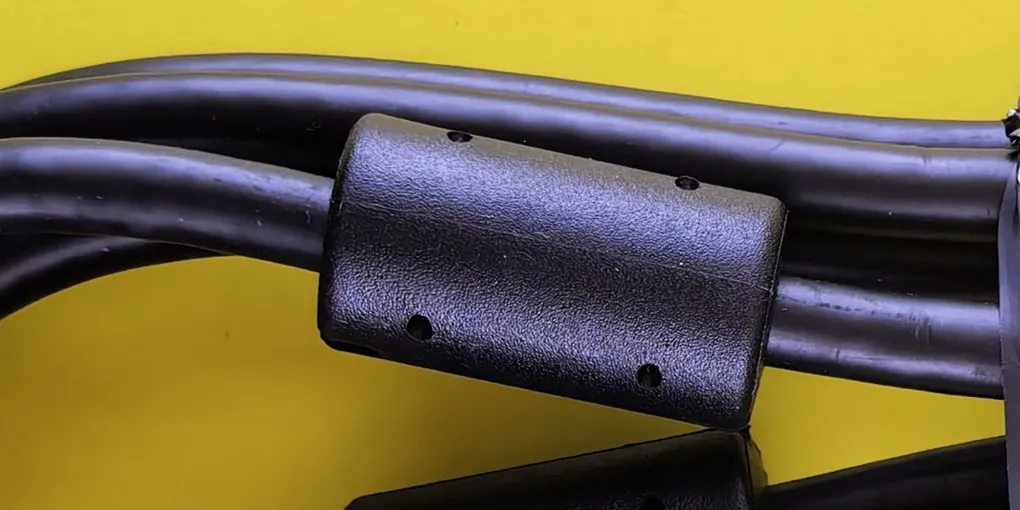
The Mysterious Lumps on Your USB Cables
If you take a look at the tangle of wires behind your desk, you will likely notice a strange design feature on a few older or heavy-duty cables: a prominent, plastic-encased cylindrical lump sitting right near the connector tip.
It looks like a random plastic weight, but it is actually one of the most elegant, low-tech solutions to a high-tech problem in modern computing. This cylinder is called a ferrite bead (or ferrite choke), and it serves as an invisible electronic gatekeeper.
Here is the story of how a specialized ceramic material transformed global technology, and why those mysterious cable lumps are slowly going extinct.
The Technical Magic: Choking the Noise
To understand what the lump does, you first have to understand a fundamental law of physics: every long metal wire is an accidental antenna.
When electricity moves through your USB cable, it creates a tiny electromagnetic field. If that field fluctuates rapidly—which happens when high-speed data is blasting down the wire—the cable starts broadcasting radio waves. Conversely, the same cable can act as a receiver, picking up stray radio signals from the air, including your Wi-Fi router, smartphone, or even a nearby microwave.
This cross-talk is called Electromagnetic Interference (EMI). Left unchecked, EMI causes noticeable electronic chaos:
- Static hiss or buzzing in your audio gear.
- Pixels flickering or dropping out on your monitor.
- Dropped data packets that can cause your mouse, keyboard, or external drive to momentarily disconnect.
Inside the Cylinder
If you were to crack open that plastic housing, you wouldn’t find any complex circuit boards or wires. Instead, you would find a simple, hollow cylinder made of ferrite—a brittle, dark ceramic compound created by blending iron oxide (rust) with other metals like nickel or zinc.
Ferrite is unique because it is highly magnetic but terrible at conducting electricity. When the high-frequency “noise” traveling along the cable enters the magnetic field inside the ferrite ring, the bead creates a massive amount of electronic resistance, or impedance.
Instead of reflecting that messy noise back into your computer, the ferrite core obeys the law of conservation of energy: it chokes the bad frequencies and converts them into tiny, harmless amounts of heat, allowing the clean, low-frequency data or power to sail through completely uninterrupted.
The Historical Twist: A University Venture That Saved TDK
While ferrite beads became a staple of 1990s and 2000s consumer electronics, the history of the material itself is a fascinating tale of academic discovery and a bitter post-war patent dispute.
Ferrite was co-invented in 1930 by two Japanese scientists at the Tokyo Institute of Technology, Drs. Yogoro Kato and Takeshi Takei. Recognizing its incredible magnetic properties, a spin-off venture company called Tokyo Denki Kagaku Kogyo was founded in 1935 to commercialize it. You probably know that company today by its acronym: TDK.
During World War II, TDK was the only company in the world mass-producing these specialized cores, primarily using them to drastically shrink the weight and size of military radio equipment.
However, across the world in the Netherlands, researchers at the tech giant Philips were independently studying the exact same compound. In 1941, Philips applied for their own ferrite patents after allegedly analyzing samples that had originated from TDK. This sparked a massive, multi-decade international patent war after 1945 over who truly owned the rights to the ceramic that powered the global electronics boom. Ultimately, both companies compromised, paving the way for ferrites to be integrated into everything from early television sets to the telephone networks that laid the groundwork for the modern internet.
The Strategic Cheat Code for Manufacturers
Why did these lumps suddenly sprout up on consumer cables in the PC era? The reason is less about engineering perfection and more about legal strategy and cost cutting.
Regulatory bodies like the U.S. Federal Communications Commission (FCC) mandate strict legal limits on how much electromagnetic radiation a consumer device can emit. If a company builds a brand-new scanner, printer, or external hard drive, they must send it to an official lab for compliance testing.
If the device fails the test because it emits too much electronic noise, the company faces a logistical nightmare: they either have to redesign the entire internal circuit board (costing months of time and thousands of dollars) or find a quick fix.
The ferrite bead is that quick fix. By simply slapping a $0.10 plastic-wrapped ferrite cylinder onto the bundled USB cable, the manufacturer can instantly suppress the excess radiation, pass the FCC test, and legally ship the product to store shelves on schedule.
Why Are the Lumps Vanishing?
If you buy a brand-new, high-end USB-C cable today, chances are it will be completely sleek, smooth, and lump-free. Ferrite beads are gradually disappearing from consumer cables for a few key reasons:
- Better Internal Shielding: Modern USB-C and HDMI cables are built with much higher manufacturing standards. They feature several internal layers of braided metal mesh and thin aluminum foil wrapped directly under the rubber jacket, blocking out noise without needing an external lump.
- Miniaturization: Component design has evolved. When modern devices do need a ferrite filter, engineers use microscopic, surface-mounted ferrite beads directly soldered onto the internal circuit board, hiding the technology entirely inside the device.
- Aesthetic Demand: Consumers prefer sleek, flexible, and highly portable cables that easily roll up into a pocket or bag. A heavy, rigid plastic barrel in the middle of a cable simply doesn’t fit modern design aesthetics.
The next time you stumble across an old USB cable with a chunky cylinder, don’t throw it out. It is a tiny, physical monument to a materials-science breakthrough that quite literally keeps our noisy digital world quiet.