The Ultimate Guide to Flying with Power Banks (2026 Edition)
Whether you are a digital nomad working from a 30,000-foot cruise altitude or a traveler trying to keep your phone alive during a grueling layover, your power bank is one of your most crucial travel companions. However, aviation authorities worldwide have significantly tightened their stance on lithium-ion batteries. If you do not know the technical specifications of your gear or the latest international airline frameworks, you risk losing an expensive piece of tech at the security checkpoint.
This absolute guide breaks down the global regulations, reveals how airline policies differ, and decodes the confusing math behind manufacturers’ capacity claims.
At a glance: The Flight-Safe Quick Answer
Legally, airport security only cares about the Wh (Watt-hour) rating (not to be confused with the commonly used W rating - see below). Unfortunately, the Wh value is rarely given in product information. Instead you can use the marketing mAh rating on the box or listing as a guide:
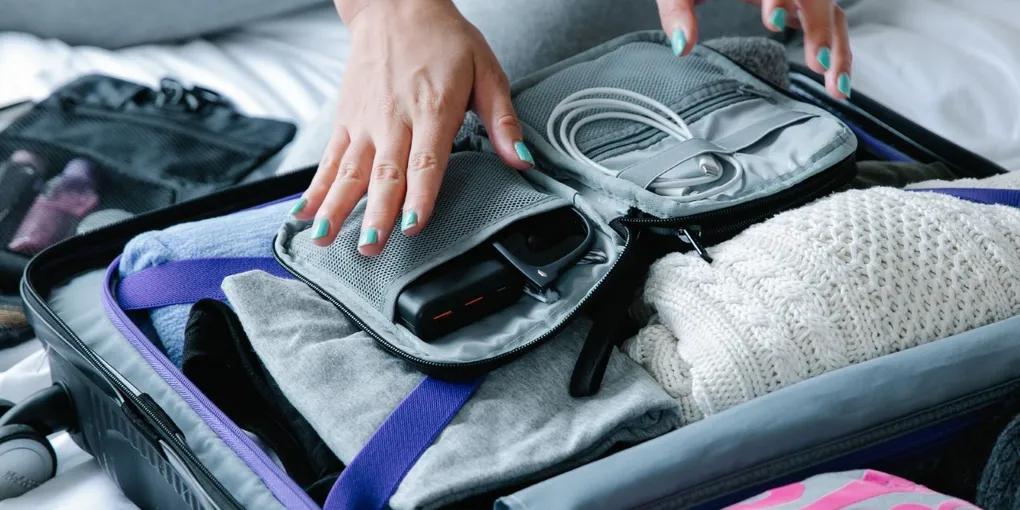
Regardless of capacity, all power banks must go in your carry-on baggage. They are completely banned from checked luggage.
⚠️ CRITICAL LEGAL DISCLAIMER: While milliamp-hours (mAh) are great for a quick ballpark estimate, aviation authorities do not legally care about mAh. Security personnel measure legality strictly by Watt-hours (Wh), which they read off your device (if the text labels are faded, scratched, or missing, security may not allow it). Read on for the full details.
1. The Global Baseline: The 100 Wh Line in the Sand
Aviation security agencies look past the standard marketing metrics. Instead, global safety standards regulated by the International Civil Aviation Organization (ICAO) and the International Air Transport Association (IATA) focus entirely on Watt-hours (Wh), which measure total energy capacity.
Across almost all international borders, the rules are split into three strict capacity tiers:
🔋 Up to 100 Wh (Permitted)
Power banks rated at 100 Wh or less are universally allowed in passenger cabins without requiring any prior airline notification or approval. Most consumer portable chargers are deliberately engineered to sit just beneath this ceiling. However, you are typically limited to a maximum of two units per passenger.
⚠️ 100.1 Wh to 160 Wh (Approval Required)
Power banks in this middle tier are heavily restricted, and you must obtain explicit approval from your operating airline before boarding. This tier generally covers massive laptop power banks or professional audio/visual equipment batteries.
❌ Over 160 Wh (Strictly Banned)
Any portable power device exceeding 160 Wh is classified as a hazardous material. It is completely banned from commercial passenger aircraft, both in checked luggage and the cabin.
2. Crucial 2026 Policy Shifts: No Checked Bags & Overhead Bans
The physical handling rules for portable chargers have grown increasingly strict. The core guidelines emphasize:
- Carry-On Baggage Only: Power banks are strictly prohibited in checked luggage. They must remain with you in the passenger cabin. While some airports screen your bags right before you check them in, most do not scan them until they are deep in the automated belly of the terminal. If you leave a power bank in a checked bag, security will flag it, and you will be publicly summoned by airport staff, exposing you to the risk of missing your flight.
- The “Two-Bank” Ceiling: Most airlines limit travelers to a maximum of two power banks total per passenger.
- The Overhead Bin Ban: Following critical in-flight battery fire incidents, most airlines have banned storing power banks in overhead bins. They must remain within reach: on your person, in an under-seat bag, or in the seat pocket.
- In-Flight Usage Restraints: Global flight guidelines strongly restrict or outright ban the charging of devices using a power bank, as well as recharging the power bank itself using the aircraft’s USB ports while in flight.
3. Decoding the Specs: Wh vs W vs mAh
Why do aviation regulations strictly dictate Wh values when consumer electronics are usually marketed using W and mAh? The answer comes down to a mix of historical manufacturing habits and basic electrical physics.
Power vs. Capacity
For any portable charger, a traveler needs to look at two primary metrics: how much energy the device stores (capacity) and how quickly it can deliver that energy (power).
- Power is measured in Watts (W): This dictates how fast a power bank can charge your laptop or phone.
- Capacity is measured in Watt-hours (Wh) or Milliamp-hours (mAh): This dictates the total pool of energy available inside the device.
Think of a Watt-hour as a measure of how long a battery can maintain a specific power output. For example, a power bank with a 20 Wh capacity can theoretically supply 2 W for 10 hours, or 5 W for 4 hours. In both scenarios, it delivers the exact same total volume of energy: 20 Wh.
Why mAh is an Indirect Metric
Milliamp-hours (mAh) do not actually measure total energy. Instead, mAh measures total current volume over time. The problem is that the actual energy carried by a current depends entirely on the voltage (V) of the battery pack. The two metrics are linked by this baseline formula:
Wh = (mAh × V) / 1000
Milliamp-hours only work as a reliable shorthand for energy capacity if the voltage remains identical across devices. This is why mAh became popular for smartphones—almost all phone batteries operate around a standard 3.6V to 3.7V baseline. If the voltage never changes, mAh serves as a perfectly fine proxy for battery life. (Note that this refers to the nominal internal cell voltage determined by battery chemistry. This is completely separate from the higher output charging voltages—like 5V, 9V, or 20V—that the device is capable of delivering through its USB ports, which are often listed in product descriptions).
The Voltage Variance Problem
Batteries have far wider applications than just smartphones, which is where mAh falls apart as a safety standard. For instance, remote-controlled (RC) cars frequently use 7.4V battery packs.
If an airline passenger packs a smartphone power bank rated at 5,000 mAh (3.7V) and an RC car battery pack also rated at 5,000 mAh (7.4V), they are not carrying the same amount of energy:
- The 3.7V Power Bank:
(5,000 mAh × 3.7V) / 1000 =18.5 Wh - The 7.4V RC Pack:
(5,000 mAh × 7.4V) / 1000 =37.0 Wh
Even though both labels display an identical “5,000 mAh” capacity, the RC pack contains exactly twice as much physical energy because its voltage is doubled. For aviation authorities assessing in-flight fire risks, the amount of energy is the only metric that matters. Therefore, international flight laws must use Watt-hours (Wh) to ensure a uniform standard across all battery types.
Why Do We Still Use mAh?
If Watt-hours are the truest metric, why does the consumer market stick with mAh? It comes down to how these values are gathered.
We cannot physically measure energy directly with a tool; we can only calculate it. In a lab, engineers physically measure current and voltage, and then multiply them to determine energy. Because cell manufacturers produce millions of batteries bound for smartphones where the operating voltage is entirely fixed, it is simplest for them to stamp the directly measured mAh value onto the cell. Power bank manufacturers simply inherited this labeling convention to stay consistent with the broader tech supply chain.
4. Flight-Safe Capacity Cheat Sheet
When buying a powerbank, first look for a Wh rating. If it’s not listed, match the mAh against this structural chart (calculated using the industry-standard 3.7V cell profile) to guarantee you pass security checkpoints seamlessly:
| Marketing Label (mAh) | Calculated Watt-Hours (Wh) | Definitive Airport Security Status |
|---|---|---|
| 5,000 mAh | 18.5 Wh | ✅ GREEN LIGHT 100% permitted in carry-on. |
| 10,000 mAh | 37.0 Wh | ✅ GREEN LIGHT 100% permitted in carry-on. |
| 20,000 mAh | 74.0 Wh | ✅ GREEN LIGHT 100% permitted in carry-on. |
| 26,800 mAh | 99.1 Wh | 🚀 MAX SAFE POINT Squeezes right under the 100 Wh cap. |
| 30,000 mAh | 111.0 Wh | ⚠️ RESTRICTED Exceeds 100 Wh; requires prior airline approval. |
| 40,000 mAh | 148.0 Wh | ⚠️ RESTRICTED Exceeds 100 Wh; requires prior airline approval. |
| 50,000 mAh | 185.0 Wh | ❌ BANNED Exceeds the absolute 160 Wh safety limit. |
5. Unspoken Airport Realities & Regional Variance
Even if the math checks out perfectly, your power bank must survive the human element at security checkpoints. Keep these operational rules in mind:
| Region & Authority | Core Policy & Enforcement Notes |
|---|---|
|
🇺🇸 United States
FAA & TSA
|
Enforces the standard 100 Wh limit for carry-on luggage. Security personnel verify specifications directly from the device casing. If the printed specifications are entirely unreadable due to wear or scratches, agents may restrict the item from passing the checkpoint. |
|
🇬🇧 United Kingdom
CAA
|
Follows standard international IATA capacity thresholds. Local screening guidelines permit standard consumer power banks in the cabin, but require that safety and compliance markings (such as CE, UKCA, or UL logos) remain clearly identifiable during routine screening. |
|
🇪🇺 European Union
EASA
|
Applies the uniform 100 Wh carry-on threshold across all member state airports. Security procedures rely strictly on the manufacturer's permanent, printed metrics on the product casing to confirm compliance before boarding. |
|
🇨🇳 Mainland China
CAAC
|
Maintains a strict verification policy regarding technical markings. Under civil aviation regulations, any power bank with faded, smeared, or entirely missing Wh or mAh markings cannot be verified by security personnel and will be denied entry past the security checkpoint. |
7. Label Legibility is Your Safety Net
You can own a fully compliant power bank, but if a security agent decides to inspect it and cannot read the capacity print on the casing, you will run into trouble.
Fortunately, in real-world travel, it is quite rare for security staff to pull out a standard, everyday phone charger just to inspect its labels. Most travelers pass through checkpoints daily without a second glance. However, if your charger sits at the larger end of the scale—like a hefty laptop power pack near the max limit—it naturally stands out more and has a higher chance of being inspected.
If your power bank is pulled aside for a check and the metrics are missing, you will find yourself with very few options in that moment. Security will not browse the manufacturer’s website for the specifications, meaning you may have to leave the charger behind or scramble to find an airport mailing service before your flight.
To cut down on this risk, simply include text durability as a factor when choosing your next portable charger. Look for manufacturers that use permanent, laser-etched labels physically engraved into the housing, rather than cheap, superficial ink stamps that rub off after a few months in a backpack. Taking a quick look at the back of your current power bank before you head to the terminal is a simple, five-second habit that ensures you never have to worry about security lines—no matter how big your charger is.