The Interface War: Why USB Won but FireWire Transformed Computing
In the late 1990s, the back of a personal computer was a chaotic wasteland of legacy ports. Parallel ports drove printers, serial ports managed external modems, and dedicated PS/2 ports handled keyboards and mice. Every device required custom drivers, unique interrupt requests (IRQs), and a prayer that the operating system wouldn’t crash upon plugin.
Two competing visions emerged to solve this mess, sparking one of the greatest architectural and strategic battles in Silicon Valley history: Apple’s FireWire versus the Intel-led USB consortium.
While Apple engineered a premium, high-speed, decentralized masterpiece, Intel deployed a cheap, highly centralized, “good enough” alternative. This is the story of how a flawless technical architecture lost to superior market economics—and how its DNA ultimately hijacked the victor.
1. The Strategic Visions: Master-Slave vs. Democratized Nodes
The battle was fundamentally an ideological war over how hardware should communicate.
Apple’s Vision: The Peer-to-Peer Republic
Engineered by Apple in the early 1990s and standardized as IEEE 1394, FireWire was built for the upcoming digital media revolution. Apple envisioned a decentralized network of smart devices.
FireWire devices were peers. Every peripheral contained its own intelligent Link Layer Controller (LLC) and Physical Layer (PHY) chips. This meant devices could bypass the computer entirely. A digital camcorder could stream video directly to an external hard drive. Because the hardware controllers handled packet routing and memory access directly via Direct Memory Access (DMA), the computer’s CPU overhead was exactly 0%.
Intel’s Vision: The Digital Dictatorship
Intel, spearheading the Universal Serial Bus (USB) consortium alongside Microsoft, Compaq, and IBM, looked at the problem through the lens of mass-market PC manufacturing. Every penny mattered.
USB adopted a strict master-slave, host-centric architecture. The peripheral was completely “dumb.” It had no autonomy, could not initiate communication, and relied entirely on the host computer’s CPU to schedule, manage, and process every single data packet. If you moved a USB mouse, the host CPU had to interrupt its current tasks to poll the port for data.
2. Technical Disruption: FireWire 400 vs. USB 1.1
When the two standards first clashed in the late 90s, it looked like a total mismatch. FireWire 400 did not just beat USB 1.1; it humiliated it.
| Technical Vector | USB 1.1 (1998) | FireWire 400 (1995) |
|---|---|---|
| Theoretical Bandwidth | 12 Mbps (Full Speed) | 400 Mbps |
| Real-World Throughput | ~1.0 - 1.2 MB/s | ~35 - 40 MB/s |
| Data Flow Lane | Half-Duplex (Alternating) | Full-Duplex (Simultaneous) |
| Bus Power Delivery | 2.5 Watts (5V, 500mA) | Up to 45 Watts (Up to 30V, 1.5A) |
| Bus Topology | Tiered Hub (Star) | Daisy Chain (Tree) |
The Streaming Bottleneck
FireWire featured native isochronous data transfer. It could guarantee a fixed slice of bandwidth to a specific device with hard time constraints. For digital video editing—where a single dropped frame meant a ruined tape capture—this was non-negotiable.
USB 1.1 relied entirely on asynchronous or interrupt-driven transfers. If the host CPU became bogged down by a heavy background application, the USB data stream stalled. Attempting to capture high-fidelity video over USB 1.1 was architecturally impossible.
The Power Paradigm
FireWire was designed to replace power cables. Delivering up to 45 watts meant professional-grade, high-RPM external hard drives could run directly off the bus power.
USB 1.1 maxed out at 2.5 watts. It was barely enough to power a low-voltage optical mouse or a flashing LED, forcing every substantial peripheral to require an external AC power brick.
3. Steve Jobs and the FireWire Tax Blunder
In 1999, Apple’s hardware engineering group felt invincible. FireWire had just been awarded a Primetime Emmy Engineering Award for its transformative impact on the television industry. Steve Jobs, recently returned to Apple, saw the interface as a core pillar of his “Digital Hub” vision. To him, the Mac would sit at the center of a consumer’s digital life, tethered to premium video cameras, audio gear, and external drives using Apple’s blistering technology.
But Jobs’ legendary premium philosophy ran headfirst into standard-setting reality. Behind closed doors, Apple shocked the 1394 Trade Association by introducing a strict $1.00 licensing royalty per port. The association, which included massive manufacturing gatekeepers like Sony, Toshiba, and Intel, instantly fractured.
Sony rebelled by stripping the power pins out of the interface to create their own variant, branding it i.LINK to distance themselves from Apple’s tax. Intel, which had tentatively planned to build native FireWire support directly into its high-volume PC controller chipsets, pulled the plug completely.
Intel executives realized that a dollar per port on hundreds of millions of consumer PCs was an impossible overhead. They pivoted entirely to funding the Universal Serial Bus consortium, guaranteeing that USB would remain completely royalty-free. By the time Jobs realized the blunder and slashed the fee to just 4 cents per port, the market had fundamentally transformed. Intel’s open architecture had captured the world’s motherboard makers, leaving FireWire locked in a premium golden cage.
4. Intel’s Counter-Attack: The USB 2.0 Mirage
Intel understood that while USB 1.1 was slow, the industry desperately wanted a royalty-free standard. In 2000, they unleashed USB 2.0 (Hi-Speed), boasting a theoretical speed of 480 Mbps—seemingly eclipsing FireWire’s 400 Mbps.
This was a masterful marketing illusion. While USB 2.0’s signaling rate was 480 Mbps, its host-centric architecture and half-duplex nature meant real-world throughput rarely crossed 30 MB/s. FireWire 400, running on full-duplex hardware controllers with DMA, sustained a rock-solid 40 MB/s without breaking a sweat.
However, the marketing worked. To the average consumer and PC builder, “480” was a bigger number than “400.” Intel had successfully neutralized FireWire’s speed advantage in the public eye.
Consumers chose cheap external drives over blazing-fast, expensive ones. Realizing their licensing blunder, Apple dropped the per-port royalty to a fraction of a cent, but the damage was done. The PC ecosystem had already standardized on USB.
In a last-ditch effort to maintain technical dominance, Apple released FireWire 800 (IEEE 1394b) in 2002. It utilized a beta-connector, hit a blistering 800 Mbps, and could run over optical cables up to 100 meters. But it was too late. USB 2.0 peripheral chips cost pennies to stamp out, while FireWire 800 silicon remained expensive.
5. Technical Deep Dive: Physical Mechanics & Pin-Out Architecture
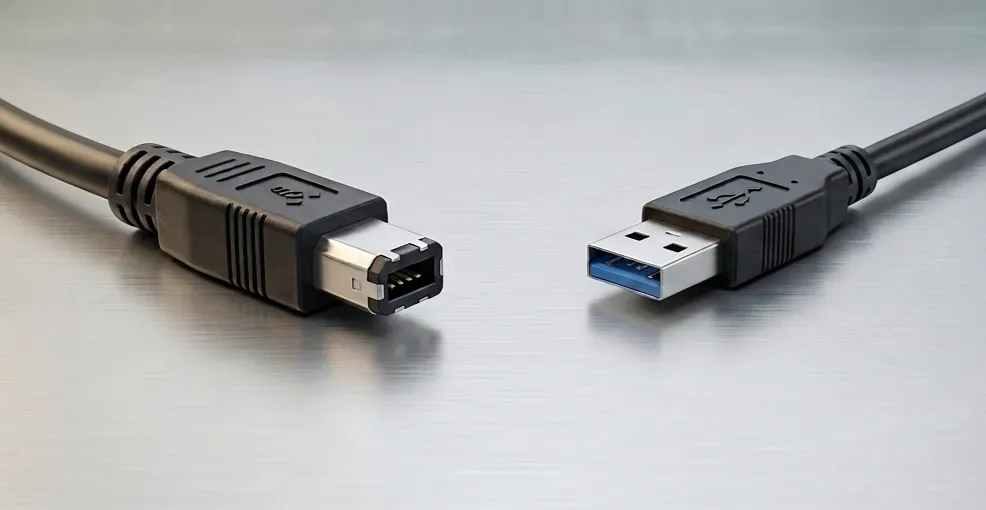
The physical differences between a USB 2.0 cable and a FireWire 400 cable highlight their contrasting engineering goals. USB focused on ultra-low physical complexity to minimize manufacturing costs, while FireWire used robust, high-tolerance industrial shielding.
VBUS
D-
D+
GND
The FireWire 400 (6-Pin) Architecture
FireWire’s connector was inspired by the rugged design of the Game Boy Link Cable, chosen for its highly reliable leaf-spring contacts that prevented accidental disconnection.
- Pin 1: VP (Power): Carried up to 30V of raw direct current.
- Pin 2: VG (Ground): Provided isolation for high-voltage power paths.
- Pin 3 / Pin 4: TPA- / TPA+ (Twisted Pair A): Handled differential data signals.
- Pin 5 / Pin 6: TPB- / TPB+ (Twisted Pair B): Handled differential strobe/clock signals.
Because it separated the data and clock lines into two distinct, high-quality shielded twisted pairs, FireWire achieved Full-Duplex communication. It could stream video in while writing metadata out simultaneously without any signal collision or packet re-transmission overhead.
The USB 1.1/2.0 (4-Pin) Architecture
USB stripped data delivery down to its absolute physical minimums, reducing cable material costs by up to 70%.
- Pin 1: VBUS: Provided a rigid 5V power rail maxing out at 500mA (2.5W).
- Pin 2: D- (Data Minus): Half of the single differential data pair.
- Pin 3: D+ (Data Plus): Half of the single differential data pair.
- Pin 4: GND: System reference ground.
With only one differential data pair (D+ and D-), USB was locked into a Half-Duplex topology. Data could only travel in one direction at a time. This created an immediate bottleneck; if a device was busy receiving a data packet, it could not send a confirmation packet back until the line fell completely silent.
6. The Niche Haven: Where FireWire Held the Line
Though it lost the mass consumer market, FireWire’s superior architecture made it an absolute titan in specific professional industries for over a decade.
- The Hollywood Standard: Throughout the 2000s, almost every professional MiniDV and HDV camcorder from Sony, Panasonic, and Canon featured a FireWire port (often branded as i.LINK). It was the only bus stable enough for real-time video editing in applications like Final Cut Pro.
- Pro Audio Recording: Multitrack audio interfaces required ultra-low latency and zero jitter. USB 2.0’s host-polling mechanism introduced unpredictable audio dropouts. FireWire sound cards could stream 32 channels of uncompressed audio simultaneously with zero CPU lag.
- Industrial Machine Vision: In automated factories and medical imaging devices, high-speed cameras used FireWire because its peer-to-peer nature allowed cameras to feed data straight into processing units without waiting for an operating system’s permission.
7. Modern Paradigm: Early Intel Controllers vs. Apple Silicon DMA
To understand why FireWire felt so much smoother than early USB, we must look at how legacy platforms handled data routing versus how modern architectures function today.
The Legacy Problem: Early Intel Host Controllers
In the late 90s and early 2000s, PC memory routing was split between a Northbridge (high-speed graphics/RAM) and a Southbridge (slower IO like USB and PCI).
When a USB device wanted to send data, it passed through a Host Controller (like Intel’s UHCI or EHCI). The host controller was incapable of writing directly to system RAM. Instead, it had to repeatedly fire an Interrupt Request (IRQ) to the primary CPU.
The CPU had to stop its execution thread, cache its current registry, handle the incoming USB packet, and manually push it into RAM. If a user was burning a CD or transferring files over USB 2.0 while playing a game, the system stuttered because the CPU was constantly managing peripheral traffic. FireWire bypassed this entire bottleneck using native Direct Memory Access (DMA), routing packets straight into memory addresses with 0% CPU help.
The Modern Resolution: Apple Silicon Architecture
Today, the architectural debate between host-centric polling and decentralized intelligence has been fully resolved by Apple Silicon (M-Series) System-on-Chips (SoCs).
- Unified Memory Architecture (UMA): Modern Apple Silicon fuses the CPU, GPU, and Secure Enclave around a singular, high-bandwidth pool of system memory.
- The Input-Output Controller (IOC): Apple Silicon utilizes a dedicated, highly advanced, proprietary IO subsystem that integrates Thunderbolt 4 and USB4 channels directly into the fabric of the chip.
- Advanced DMA Lanes: When you plug a high-speed NVMe drive into an M-series Mac via a Type-C port, the modern USB4 subsystem deploys deep hardware DMA paths reminiscent of FireWire’s original design philosophy. The IO controller streams tens of gigabits of data directly into Unified Memory at the hardware level, completely isolating the primary CPU cores from the packet-routing process.
The Ultimate Irony: FireWire’s Ghost Inside USB4
By the early 2010s, Apple began systematically removing FireWire ports from its MacBooks, replacing them with a new architecture developed alongside Intel: Thunderbolt.
Thunderbolt abandoned the host-centric, master-slave paradigm of traditional USB. Instead, it adopted a high-speed, direct-to-CPU architecture featuring Direct Memory Access (DMA) and daisy-chaining capabilities. It was, in spirit, the modern evolution of FireWire’s design philosophy.
As the industry moved toward Type-C connectors, the USB Implementers Forum integrated Thunderbolt 3 specifications directly into the open USB4 standard.
The ultimate historical irony is clear: USB won the market war by being cheap, dumb, and centralized. But as data demands grew exponentially, that simple architecture choked. To survive the modern era, USB had to kill its own architectural heritage and adopt the exact decentralized, intelligent, high-power principles that Apple’s FireWire championed decades ago.